Last Updated: October 26, 2026
Quick Summary
License plate recognition works for businesses by capturing a vehicle's plate, converting the characters to text with optical character recognition, and matching that text against a watchlist or database in real time. A true LPR camera needs one unit per lane, a straight-on mounting angle, and infrared illumination for night reads.
- Dedicate one camera per lane, since one camera watching two lanes splits resolution and reads neither well.
- Keep the plate roughly square to the lens; mounting too high distorts the plate and shortens readable distance.
- Pair infrared illumination with a fast shutter so motion blur does not ruin night plate reads.
- A working LPR-to-gate workflow needs the camera, software or VMS, a controller or relay, and an alerting layer.
- Test accuracy for a week against a ground-truth plate list, then repeat the test at night and after weather.
Table of Contents
- How License Plate Recognition Cameras Work for Businesses
- License Plate Camera Placement: Mounting Angles, Distance, and Field of View
- LPR Camera Night Vision: Infrared, Shutter Speed, and Low-Light Performance
- Business Parking Lot Security Cameras: Planning Coverage for Entrances and Exits
- Vehicle Access Control for Businesses: Tying Plate Reads to Gates, Alerts, and Records
- Privacy, Retention, and Legal Considerations for Plate Data
- Accuracy Testing, Maintenance, and the Ongoing Cost of an LPR System
- Schedule a Free Commercial Security Assessment
- Frequently Asked Questions
How License Plate Recognition Cameras Work for Businesses
A vehicle rolls through your lot at 2 a.m., and by morning you have a timestamped plate number, a photo, and an alert that fired the moment it happened.
License plate recognition is a camera and software system that captures a vehicle's plate, converts the characters into text using optical character recognition, and matches that text against a watchlist or database in real time.
From Plate Capture to Real-Time Alert
The process runs in four dependent stages.
- Detection - The camera senses a vehicle entering its zone, often through motion or a trigger from a loop or gate sensor.
- Capture - A short burst of frames fires at high shutter speed, freezing the plate as the vehicle moves.
- OCR conversion - Software isolates the plate region, cleans up the image, and translates pixels into characters.
- Matching and alerting - The read is compared to your lists. A match, or an unrecognized plate at a restricted gate, triggers a notification to your phone, your security operations desk, or your access control system.
What Separates a True LPR Camera From a Standard Security Camera
A true LPR camera is purpose-built for plate capture, with four hardware differences from an ordinary camera.
- Higher resolution on a narrow target. A 4MP camera dedicated to a single lane keeps more pixels on the plate itself.
- Motorized varifocal lens. You can dial in the exact field of view at install instead of accepting a fixed wide angle.
- Infrared illumination tuned for plates. Retroflective plates bounce IR light back efficiently, so the camera can read them in near darkness.
Here is the four-stage process every LPR read runs through, from the moment a vehicle enters the zone to the alert on your phone.
| Stage | What happens |
|---|---|
| Detection | Camera senses a vehicle entering its zone |
| Capture | Short burst of frames at high shutter speed |
| OCR conversion | Software translates plate pixels into characters |
| Matching and alerting | Read compared to your lists; match triggers notification |
License Plate Camera Placement: Mounting Angles, Distance, and Field of View
License plate camera placement decides whether your system reads plates reliably or produces a folder of blurry guesses. Get the geometry right before you buy.
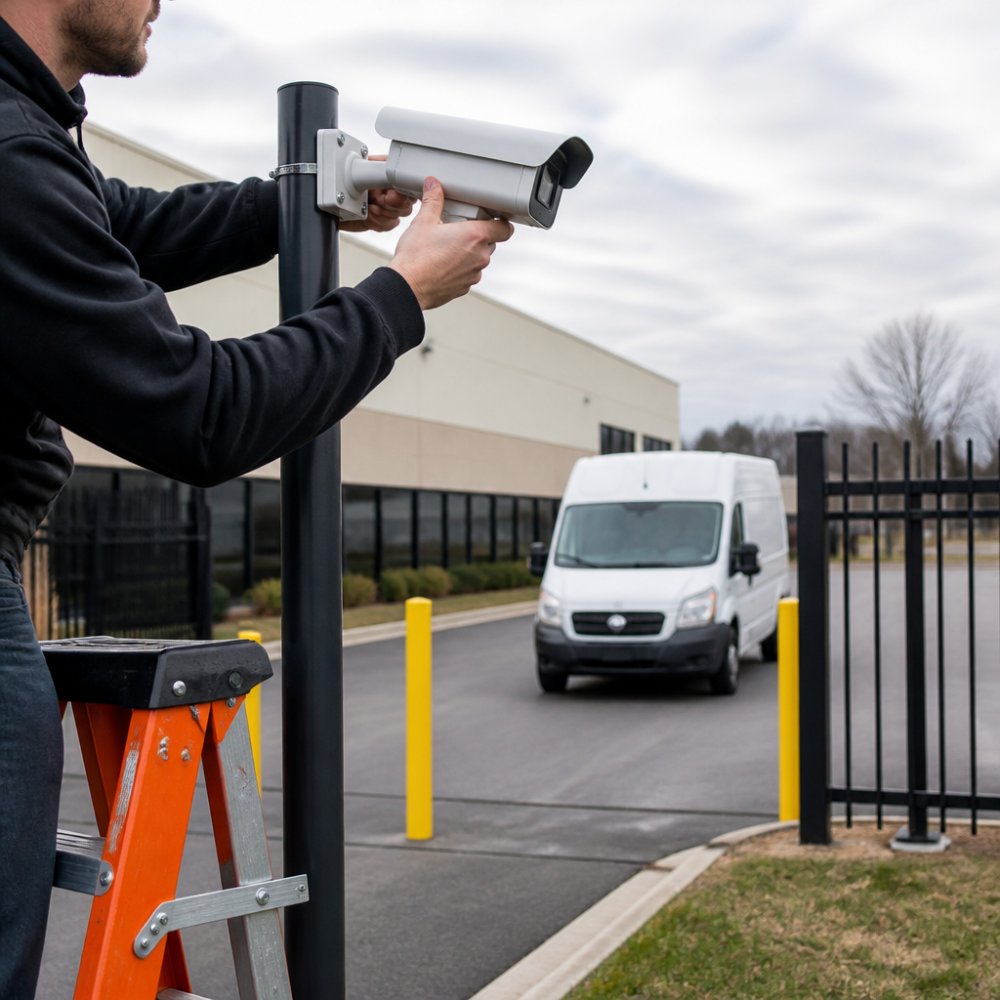
The biggest mistake is mounting too high. A steep downward angle distorts the plate and shortens readable distance, so keep the plate roughly square to the lens as the vehicle passes.
Three placement rules cover most lots:
- Dedicate one camera per lane. One camera watching two lanes splits its resolution and reads neither well.
- Position for a straight-on or slight angle view. Extreme angles cut characters off the frame.
- Keep the capture zone clear of obstructions. Signage, tree limbs, and parked trucks all break reads.
Lens Choice, Capture Distance, and Vehicle Speed
Lens selection and capture distance are locked together. A varifocal lens narrows the field of view to the plate lane, extending usable capture distance without adding resolution. Vehicle speed changes the math: a slow car at a gate gives the camera time to fire multiple frames, while a vehicle at road speed needs a faster shutter and a tighter capture zone.
LPR Camera Night Vision: Infrared, Shutter Speed, and Low-Light Performance
LPR camera night vision depends on infrared illumination and a fast shutter, not megapixels. Most business plate reads happen after dark, so this spec decides whether the system earns its keep.
Infrared illumination lights the plate without visible light, and retroreflective plates return that light strongly. Pair it with a short exposure and the plate stays sharp even as the vehicle moves.
Business Parking Lot Security Cameras: Planning Coverage for Entrances and Exits
Business parking lot security cameras should cover every entrance and exit, plus the lanes between them. LPR is one layer of that plan, not the whole plan.
Map your lot before you buy. Identify each vehicle entry and exit, then decide which need plate capture and which need overview coverage. To see our commercial security services and book a design walkthrough, explore our commercial security systems.
A practical coverage plan looks like this:
- Entrance lane: one LPR camera per lane, aimed at the plate zone.
- Exit lane: one LPR camera per lane, capturing departing vehicles.
- Lot overview: wide cameras covering parking rows and building faces.
Vehicle Access Control for Businesses: Tying Plate Reads to Gates, Alerts, and Records
Vehicle access control for businesses turns a plate read into an action. Instead of just logging a number, the system opens a gate for an approved plate, alerts staff to an unknown one, or holds a barrier until someone verifies. That is the difference between a camera that records and a system that works.
The Four Pieces Between the Camera and the Gate
A working LPR-to-gate workflow has four parts, each specified before install.
- The LPR camera captures the plate and runs onboard OCR, outputting a text string plus a timestamp and an image crop.
- The LPR software or VMS receives that read, matches it against your lists, and decides what happens next. This can be a dedicated LPR platform, a video management system with an LPR module, or a cloud service.
- The controller or relay is the physical bridge to your gate, barrier, or door strike. The software sends a dry-contact signal, and the controller opens the gate.
If any one of those four is missing or mismatched, the workflow breaks.
Watchlists, Allow Lists, and Alert Logic
The software defines who gets in and who gets flagged. Most business deployments use three lists:
- Allow list, tenant, employee, or fleet plates that trigger automatic gate opening during set hours.
- Watch list, plates that should trigger an alert to management or security, such as a vehicle tied to a prior incident or a banned repeat visitor.
- Unknown plates, everything else. You decide whether unknowns get a courtesy alert, a hold-and-verify prompt at an intercom, or nothing at all.
A common pattern is to allow-list during business hours and tighten to watch-list-only after close, keeping deliveries and staff moving without leaving the gate wide open overnight.
Records, Search, and Business-System Ties
Every read should be stored with the plate text, image crop, full frame, camera ID, and timestamp, so you can search by plate, date, or time later, for a delivery dispute, an insurance claim, or a police request. Reads can also feed other business systems:
- Visitor logs, a searchable record of every vehicle that entered the property.
- Delivery tracking, match carrier plates to expected shipments and flag arrivals.
- Tenant records, for multi-tenant properties, tie reads to lease or parking assignments.
ADT business features include access control, commercial-grade cameras, intercoms, and multi-location management, and a certified advisor can map how plate reads flow into those systems.
What to Specify Before You Sign
Ask four questions of any LPR proposal:
- What software receives the read, and is it licensed per camera, per lane, or per site?
- What controller opens the gate, and does it fail safe or fail secure if the network drops?
- How are alerts delivered, app push, text, email, or a monitored security desk?
- How long are reads retained, and who can search them?
To see how business-grade camera and access control options fit together, explore our commercial security systems and book a design walkthrough.
Privacy, Retention, and Legal Considerations for Plate Data
Plate data is personal information in many contexts, and businesses should treat it that way. Store only what you need, keep it only as long as you need it, and restrict access (the FTC).
A few practical guardrails:
- Post signage letting visitors know cameras are in use.
- Set a retention window and delete reads on schedule.
- Limit access to authorized staff only.
Check your obligations with counsel, since rules vary by state and use case. If you have privacy or data questions, review our frequently asked questions for how our systems and monitoring handle footage.
Accuracy Testing, Maintenance, and the Ongoing Cost of an LPR System
Accuracy testing tells you whether your LPR system actually works. Vendor read-rate claims are not the same as your read rate on your lot, in your lighting, with your traffic. The only way to know is to measure.
A Repeatable Accuracy Test You Can Run in a Week
You do not need a lab. You need a known set of plates and a way to compare what the system read against what actually drove through.
- Build a ground-truth list. For one week, have a staff member log every plate that enters and exits during a set window, say, 7 a.m. to 7 p.m., with the time and lane. A clipboard or a shared spreadsheet works.
- Pull the system's reads for the same window and match them against the ground-truth list by timestamp.
- Count four things: reads that match exactly, reads that are close but wrong (one character off), reads that missed entirely, and reads that fired for a plate that was not there.
- Repeat at night. Run the same test for a 7 p.m. to 7 a.m. window, because night reads are where most systems separate.
- Repeat after weather. Run it again after a rain event and after the first snow, since wet plates and low winter sun change the math.
The KPIs to Track
Four numbers tell you whether the system is earning its keep:
- Read rate, the percentage of ground-truth plates the system read correctly. Track it separately for day and night.
- False read rate, reads that fired for a plate that was not present, or that matched the wrong vehicle. High false reads erode trust in alerts.
- Capture rate by condition, read rate broken out by lighting, weather, and vehicle speed. This is where you find the lane that needs a camera adjustment.
Track these monthly. A drop in any one is a signal to clean a lens, re-aim a camera, or check a network link before it becomes a security gap.
Maintenance That Actually Matters
Maintenance is simple but not optional:
- Clean lenses on a schedule, and after any pollen, dust, or road-salt season.
- Clear obstructions, tree limbs, signage, and parked trucks all break reads.
- Re-verify the capture zone after any lot change, including new striping, new signage, or a re-paved entrance.
Seasonal shifts matter too. Snow banks can block a low-mounted camera, and low winter sun can wash out a west-facing lane that worked fine in summer.
Total Cost of Ownership Beyond the Camera
The camera's purchase price is the smallest line in most LPR budgets. Full cost of ownership includes:
- Camera hardware, one per lane, plus mounting and housing.
- Software or licensing, often priced per camera, per lane, or per site, and often recurring.
- Storage, local NVR storage or cloud retention, sized to your retention window.
Pricing depends on lane count, integration needs, and site conditions, so call 414-793-8532 for current pricing. Before you sign anything, read our guide to choosing a security provider and review our frequently asked questions for how our systems handle footage and retention.
Schedule a Free Commercial Security Assessment
The fastest way to know whether LPR fits your property is a walkthrough with someone who designs these systems for a living.
Protection Pros USA has served Milwaukee and southeastern Wisconsin since 2014, and our team designs, installs, and supports ADT-monitored systems with 24/7 professional monitoring. For homeowners, we also offer a free full home security system with a $99 installation charge and a 36-month monitoring agreement at $72.99 per month. That includes door sensors, a glass break sensor, a 7-inch ADT Command touchscreen panel, plus your choice of a Google Nest Doorbell or Google Nest Cam at no cost. Early termination fee applies.
Call 414-793-8532 or request your free quote at protectionprosusa.com. Every assessment is free, no obligation, with a response within 24 hours.
Your lot already tells a story every night. The question is whether you can read it.
*$99 Customer Installation Charge. 36-Month Monitoring Agreement required at $72.99 per month.
Frequently Asked Questions
Can security cameras reliably read license plates at night?
Yes, if the camera is built for it. True license plate recognition cameras pair infrared illumination with a fast shutter and exposure settings tuned for moving vehicles, so plates stay legible after dark. A standard camera with night vision usually produces blur or glare instead. Placement matters just as much: mount the camera low and close to the lane, and keep headlights from pointing straight into the lens. Ask for a nighttime demonstration before you commit.
Where should a business install license plate recognition cameras?
Start with every vehicle entrance and exit, not the middle of the lot. License plate camera placement works best when the camera sits within a short, fixed distance of the plate and at a shallow angle, ideally under 30 degrees off the plate's face. One camera per lane prevents missed reads when two vehicles pass at once. If your lot has a second driveway or a rear alley gate, cover it too, since employees and vendors often use the back way in.
Are license plate recognition cameras worth it for a small business?
For many businesses, yes. An LPR camera gives you a searchable record of every vehicle that entered your property, which helps with theft investigations, false damage claims, and repeat-trespasser cases. It also supports vehicle access control for businesses that want gates to open only for known plates. The value depends on your layout: a single well-placed camera at one entrance costs far less than covering a sprawling lot. A free on-site assessment will show what your property actually needs.
How should businesses store and manage license plate data?
Treat plate data like any other business record. Set a retention window that matches your purpose, such as 30 or 90 days, and delete older reads automatically. Restrict access to managers who need it, keep the recorder or cloud account password-protected, and document who reviewed footage and when. Check your state and local rules before sharing plate data with anyone outside your business. Pairing LPR with a professionally monitored ADT system keeps video and alarms under one managed account.